Choosing the Right MI Thermocouple Sheath: Stainless Steel vs. Inconel
The sheath is the only part of an MI thermocouple that touches your process, and it sets the sensor's real service life. Here's how 304/316/310/321 stainless steel and Inconel 600 compare, and which one fits your operating conditions.
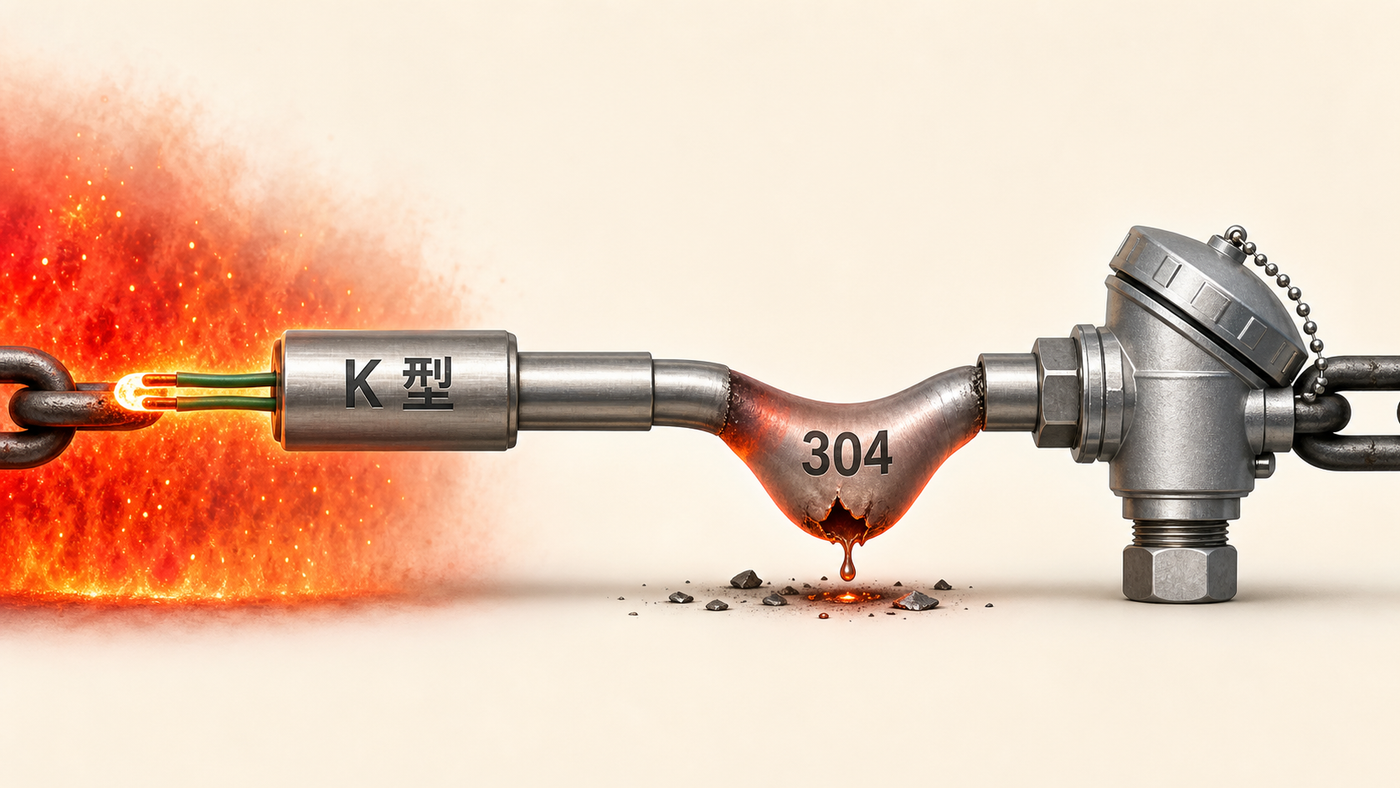
The sheath is the only part of an MI thermocouple that comes into contact with the process. The thermocouple type determines how accurately it measures; the sheath material determines how long it lasts. Once the sheath is perforated or deformed, the magnesium oxide inside absorbs moisture and the sensor fails.
The Two Factors That Matter
- Temperature ceiling — whether the sheath softens, oxidizes, or deforms at the target temperature.
- Corrosion resistance — whether the process medium (gas or liquid) attacks the sheath.
Both conditions must hold at once. A material that survives 1200°C may not survive sulfur-bearing flue gas, and a material that resists acids and alkalis may fall short at high temperatures.
Common Sheath Materials
304 Stainless Steel
The most common sheath material. Rated to roughly 900°C and stable in dry air and general industrial environments. Lowest cost and fastest availability.
Good for: standard furnace monitoring, HVAC systems, food processing, and general industrial measurement.
Avoid: chloride-bearing environments (prone to stress-corrosion cracking) and applications above 900°C.
316 Stainless Steel
Adds molybdenum to the 304 composition, markedly improving corrosion resistance. Rated to the same roughly 900°C, but tolerates chlorides and acidic media far better than 304.
Good for: chemical environments, marine climates, and media containing chlorides or weak acids.
Avoid: temperatures above 900°C and strongly reducing atmospheres.
310 Stainless Steel
Higher chromium and nickel content pushes the ceiling to about 1100°C. Excellent oxidation resistance at high temperature, but less corrosion-resistant than 316.
Good for: high-temperature furnaces, heat treating, ceramic sintering, and other dry, high-temperature environments.
Avoid: sulfur-bearing atmospheres (severe sulfidation at high temperature) and strongly corrosive media.
321 Stainless Steel
Adds titanium to the 304 composition to solve 304's susceptibility to intergranular corrosion in the 800–900°C range. Rated to roughly 900°C, but resists corrosion better than 304 in welded heat-affected zones.
Good for: heavily welded assemblies and long-term operation near 800°C.
Avoid: temperatures above 900°C and strong-acid or high-chloride environments.
Inconel 600
A nickel-based alloy rated to about 1200°C, resistant to oxidation, carburization, and chloride stress-corrosion. The best all-around MI thermocouple sheath material — and the most expensive.
Good for: aerospace engines, gas-turbine exhaust, high-temperature corrosive flue gas, and carburizing furnaces.
Avoid: sulfur-bearing reducing atmospheres (high-temperature sulfidation) and budget-sensitive projects.
Quick Selection Guide
| Conditions | Recommended sheath | Alternative |
|---|---|---|
| General industrial, <900°C | 304 | — |
| Humid or mildly corrosive, <900°C | 316 | 304 (for light corrosion) |
| High temperature, dry, <1100°C | 310 | Inconel 600 |
| Many welded joints, <900°C | 321 | 304 |
| High temperature + corrosive, <1200°C | Inconel 600 | — |
One Common Mistake
Looking only at the thermocouple type's temperature range and ignoring the sheath's ceiling. A Type K is rated to 1350°C, but a 304 sheath starts to soften before it reaches 900°C. Pair a Type K with a 304 sheath and your actual usable limit is 900°C — not 1350°C.
The sheath's temperature ceiling is the real operating boundary of the whole MI thermocouple.