What Is an MI Thermocouple? A Guide to Mineral Insulated Temperature Sensors
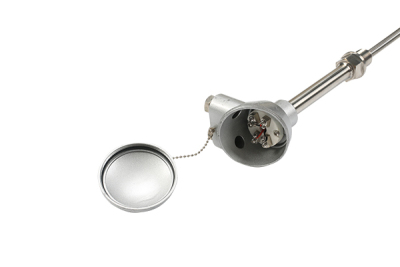
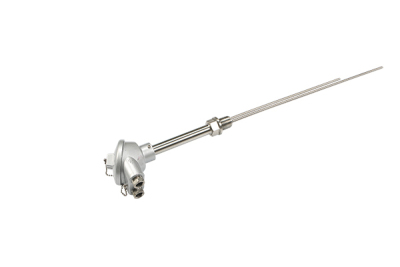
A mineral insulated (MI) thermocouple is a temperature sensor built by compacting two thermocouple wires, magnesium-oxide insulation, and a metal sheath into a single flexible, vibration-tolerant cable.
What Does "MI" Stand For?
MI stands for Mineral Insulated. The construction has three layers:
- Metal sheath — the outermost layer, usually stainless steel, an Inconel alloy, or another corrosion-resistant alloy. It contacts the measured environment directly and provides mechanical protection.
- MgO insulation — the middle layer, made of compacted magnesium-oxide (MgO) powder. Magnesium oxide both insulates and conducts heat: it keeps the two thermocouple wires electrically separated while passing heat quickly to the measuring junction.
- Thermocouple wires — the innermost layer, two wires of different metal alloys welded together at the tip to form the measuring junction (the hot junction).
The three layers are drawn down and compacted into a single dense metal tube with no air gaps and no moving parts. That is the fundamental difference between an MI thermocouple and a conventional ceramic-bead thermocouple.
How Is an MI Thermocouple Made?
Manufacturing takes four steps:
- The thermocouple wires are inserted into a metal tube, and the space between them is filled with magnesium-oxide powder.
- Repeated drawing passes reduce the tube diameter while compacting the MgO, leaving a dense, void-free insulation layer.
- The end is sealed by welding to keep the MgO dry — exposed to air, magnesium oxide absorbs moisture and loses insulation resistance.
- The measuring junction is welded at the other end, either grounded (junction connected to the sheath) or ungrounded (junction isolated from the sheath).
Finished cables range from 0.5 mm to 8 mm in diameter and from tens of centimeters to tens of meters in length.
Common Thermocouple Types and Temperature Ranges
Note: always confirm with the supplier's datasheet or the relevant standard for engineering selection.
| Type | Positive / negative leg | Recommended range | Notes |
|---|---|---|---|
| Type K | Ni-Cr / Ni-Al | -200 to 1250°C | The most common type; performs well in oxidizing atmospheres and offers the best value |
| Type J | Fe / Cu-Ni | 0 to 750°C | Low cost, works in reducing atmospheres, but the iron positive leg oxidizes readily |
| Type N | Ni-Cr-Si / Ni-Si-Mg | -200 to 1250°C | More stable than Type K, with lower drift at high temperatures |
| Type E | Ni-Cr / Cu-Ni | -200 to 900°C | Highest EMF output; ideal for high-sensitivity, low-temperature measurement |
| Type T | Cu / Cu-Ni | -200 to 350°C | Good accuracy at low temperatures; suited to sub-zero and cryogenic ranges |
Sheath material matters just as much. Stainless steel sheaths (304/316/310/321) cover most applications, while an Inconel 600 sheath handles high-temperature and corrosive environments. The sheath's temperature ceiling defines the actual operating limit of the whole MI thermocouple.
Key Properties
Bendable, fits tight spaces
An MI thermocouple bends like a cable, with a minimum bend radius of roughly 2–3 times its diameter. That lets it snake through narrow piping, curved channels, and compact equipment internals to reach measuring points a rigid sensor can't.
Vibration and shock tolerant
The compacted one-piece construction has no air gaps and no loose parts, and the MgO insulation provides mechanical support. In high-vibration environments such as engines, compressors, and turbines, an MI thermocouple outlasts a ceramic-bead type by a wide margin.
Fast response
The metal sheath contacts the measured medium directly, and the thin, thermally conductive MgO layer keeps the heat path from sheath to junction short. A grounded junction (hot junction welded to the sheath) can respond in under 0.1 seconds.
Long runs without joints
MI thermocouple cable is produced continuously in runs of tens of meters, with no joints or welds along the way. In deep-well, long-pipe, and reactor-internal measurements, fewer joints mean fewer failure points.
Water- and moisture-resistant (when sealed)
Magnesium oxide is hygroscopic, but a welded end seal or epoxy potting keeps moisture out. A properly sealed MI thermocouple can operate in humid environments and even immersed in liquid long-term.、
MI Thermocouple vs. Conventional Thermocouple
| Aspect | MI thermocouple | Conventional ceramic-bead thermocouple |
|---|---|---|
| Construction | Metal sheath + compacted MgO + wires, swaged into one body | Wires threaded through ceramic beads, inside a protection tube |
| Outer diameter | 0.5–8 mm | Generally thicker, limited by the protection tube |
| Flexibility | Bendable, min. bend radius 2–3× the diameter | Not bendable; ceramic beads are brittle |
| Vibration resistance | Good — compacted, no loose parts | Poor — beads can fracture under vibration |
| Response time | Fast — sheath conducts heat directly | Slower — protection tube and air gap add thermal resistance |
| Cost | Moderate | Lower |
| Best for | Industrial sites, harsh environments, tight spaces | Laboratories, low-vibration environments, budget-sensitive work |
Typical Applications
- Aerospace — exhaust gas temperature, turbine blade temperature, and combustion chamber monitoring. Vibration tolerance and high-temperature performance are hard requirements here.
- Automotive — exhaust gas temperature, catalytic converter temperature, and brake system temperature. Small-diameter MI thermocouples fit into tight measurement points.
- Heat treating — furnace temperature-uniformity surveys and internal workpiece temperature monitoring. Long MI thermocouples reach deep into furnace zones.
- Power generation — generator bearing temperature, transformer winding temperature, and cable joint temperature. The bendable construction routes easily inside equipment.
- Chemical processing — reactor internal temperature and pipeline media temperature. Corrosion-resistant sheath alloys suit a range of chemical environments.
- Food processing — baking, cooking, and cold-chain temperatures. Stainless steel sheaths meet hygienic requirements.
How to Specify an MI Thermocouple
- Temperature range — confirm the measured span, then choose the matching thermocouple type and sheath material.
- Sheath material — select 304/316/310/321 stainless steel or an alloy such as Inconel based on corrosion resistance and temperature ceiling.
- Diameter — thinner cable responds faster but has lower mechanical strength; balance space and response requirements.
- Length — the distance from the measuring point to the termination, plus installation allowance.
- Junction style — grounded (fast response, hot junction connected to the sheath) or ungrounded (electrically isolated, slightly slower).
- End seal — confirm the sealing method (welded seal or epoxy potting) for humid environments.
Need a custom MI thermocouple? Send us your process conditions and installation requirements, and we'll match you with the right configuration.